- euros
Ancient urban code
Architectural Pulse
- 70 x 50 cm
€4,300
euros
Architectural Pulse explores the city as a living rhythm — an environment shaped by repetition, interruption, density, and continuous movement. The composition gathers around a broad horizontal urban field suspended within an expansive pale space. Architectural fragments, geometric planes, and small accents of blue, ochre, rust, and turquoise accumulate into a dense visual fabric. Rather than forming recognizable buildings, these elements suggest the underlying rhythm of construction — a city continually assembling, changing, and reorganizing itself. An intricate network of fine lines passes through and beyond this central structure. Vertical marks rise like structural coordinates, while diagonals and horizontals intersect across the surface, evoking routes, infrastructure, circulation, and communication systems. Their varying density creates a visual cadence: moments of compression alternate with areas of openness and silence. The restrained background allows this urban concentration to appear almost suspended in space. Its boundaries remain uncertain, as though the city were expanding through invisible connections rather than through physical form alone. In Architectural Pulse, Vahagn Bagoyan shifts attention from architecture as a collection of static objects to architecture as rhythm and process. The metropolis becomes a dynamic system whose identity emerges from the constant interaction of structures, trajectories, and human movement — the pulse that keeps the city alive.
2025
Acrylic painting
- euros
€4,300
euros
Stone that Holds the Cosmos
- 61 x 51 cm
- euros
€9,000
euros
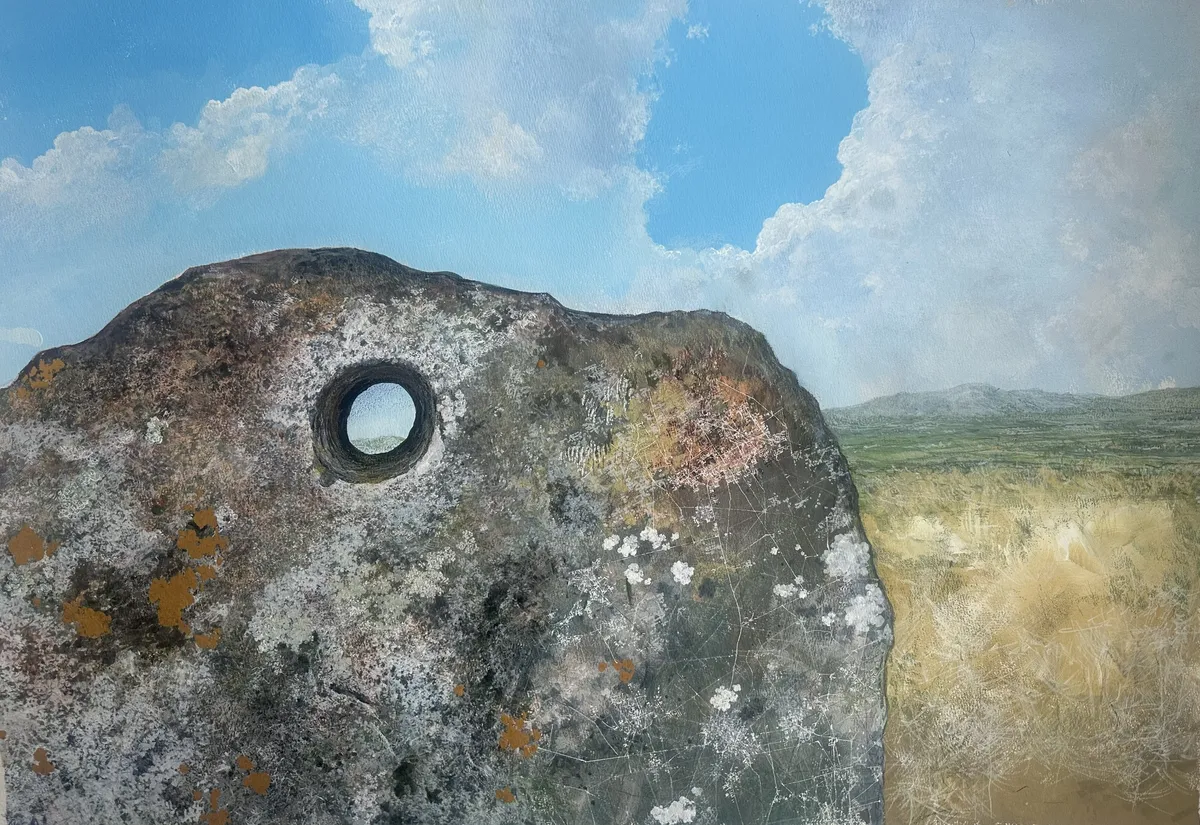
Stone that Holds the Cosmos explores Karahunj as a meeting point between earth, memory, and the infinite space beyond the visible landscape. A monumental stone dominates the composition, its characteristic circular opening framing a fragment of the distant horizon. Behind it stretches the open Armenian landscape of Karahunj, while the stone itself seems to contain another realm. Across its weathered surface, earthly texture gradually gives way to a deep, star-filled space — as though the cosmos were not above the ancient monument, but held within its material. This inversion lies at the heart of the work. Stone, traditionally associated with weight, permanence, and the earth, becomes a vessel for something immeasurable and infinite. Nebulous forms, points of light, and celestial depths emerge from its surface, transforming the ancient object into a threshold between the tangible and the unknowable. The circular opening intensifies this relationship. It is simultaneously a physical feature of the Karahunj stone and a visual passage through it, connecting the intimate scale of human perception with landscape, sky, and cosmic distance. Rather than offering a literal interpretation of Karahunj or making a historical claim about its function, Vahagn Bagoyan uses the site as a poetic space in which different dimensions of time can coexist: geological time, human memory, and cosmic time. In Stone that Holds the Cosmos, the ancient stone becomes more than an archaeological presence. It appears as a keeper of time and space — rooted in the Armenian landscape while carrying, metaphorically, an entire universe within its surface.
2025
Acrylic painting
This painting depicts a megalithic stone with a circular hole at its center, standing in an open, ancient landscape. Likely inspired by the Armenian site of Karahunj (Zorats Karer), the scene evokes a sacred connection between earth and cosmos. The central stone becomes a silent observer — its eye-like hole revealing the sky and distant horizon. Its textured surface, covered in lichen and subtle cosmic dust, blurs the line between matter and mystery. Scattered stones and grasses populate the field, while clouds drift in the background, adding to the timeless atmosphere.
- euros
€9,000
euros
Ancient urban code
- 78 x 55 cm
- euros
€18,000
euros
Ancient Urban Code creates a dialogue between one of Armenia’s most enigmatic ancient landscapes and the spatial logic of the contemporary city. At the center of the composition stands a stone inspired by Karahunj, the prehistoric archaeological site in Armenia known for its monumental standing stones, some pierced by distinctive circular openings. Set against an expansive Armenian landscape, the stone carries the physical presence of deep time — weathered, monumental, and marked by traces that precede the modern city by millennia. Yet across its ancient surface, another system appears: a contemporary urban master plan. Fine networks of streets, intersections, routes, and spatial connections spread over the stone like an encoded inscription. The geometry of the modern city seems not simply imposed on the ancient object, but discovered within it—as though patterns of human settlement and spatial organization belonged to a much longer continuum. The characteristic circular opening becomes a powerful point of connection. Through it, the landscape remains visible, linking stone, territory, and horizon while suggesting a passage between different perceptions of space and time. By bringing Karahunj and the urban master plan into the same visual field, Vahagn Bagoyan connects two radically distant forms of human spatial thinking: the marking of territory in the ancient world and the complex organization of contemporary urban space. In Ancient Urban Code, the city becomes an archaeological possibility. The master plan appears as a code inscribed across time — suggesting that the human impulse to organize, connect, and give meaning to space is far older than the modern metropolis itself.
2025
Acrylic painting
- euros
€18,000
euros