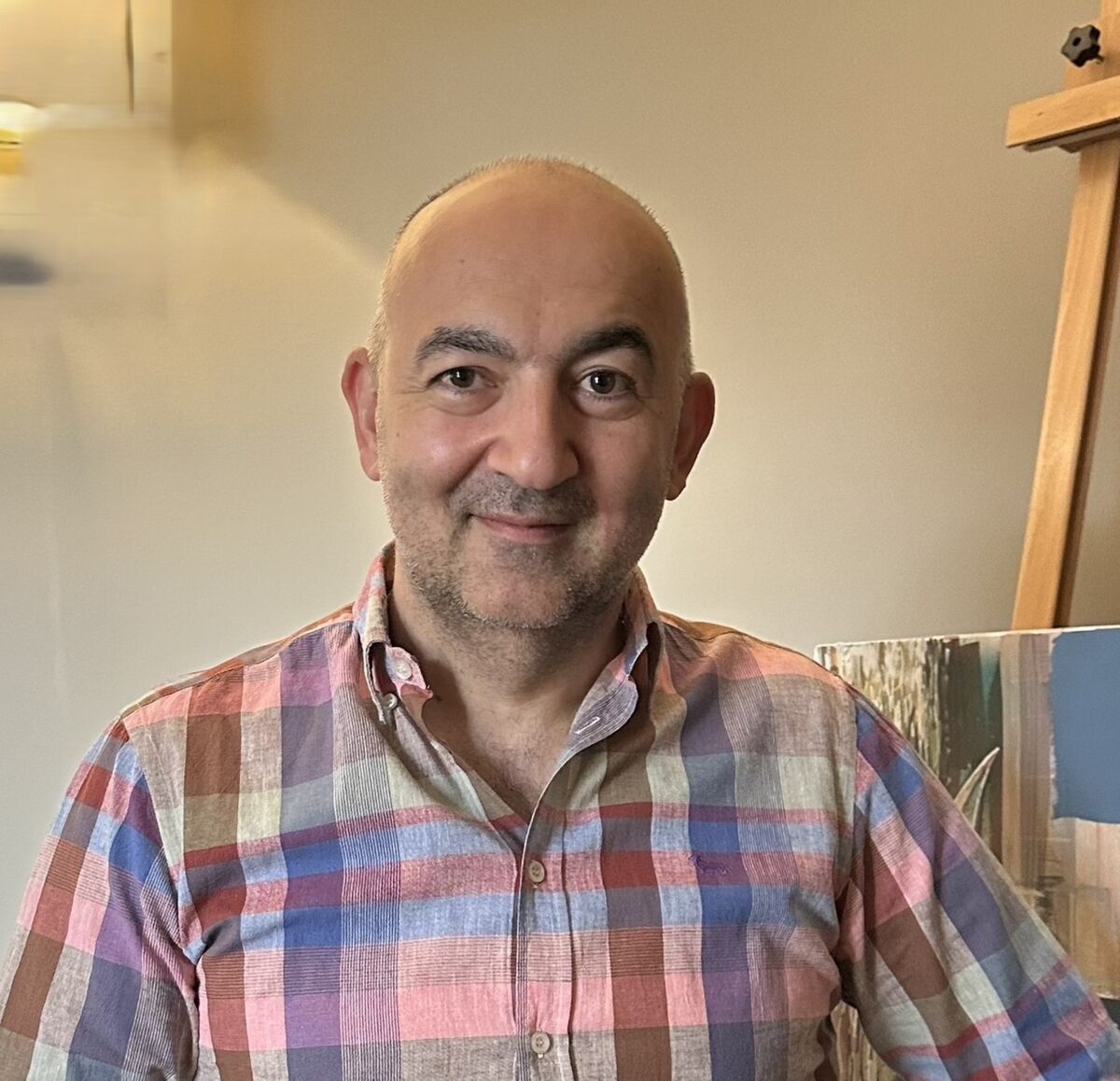
BIOGRAPHY
Vahagn Bagoyan is an Armenian contemporary artist and architect whose work bridges the structured logic of architectural design with the intuitive freedom of abstract painting. His artistic practice explores the relationships between geometry and atmosphere, order and spontaneity, memory and transformation.
Drawing inspiration from urban landscapes, aerial perspectives, architectural structures, and the traces of ancient civilizations, Bagoyan creates layered compositions that investigate the invisible systems shaping our perception of space.
His ongoing series, Linear Cities, explores the city as a living, continuously evolving organism. Through intersecting lines, shifting horizons, and complex spatial relationships, his paintings reflect the expansion, transformation, and regeneration of urban environments.
In Master Plans, Bagoyan approaches space through abstract cartographic structures, exploring the relationships between geometry, organization, and the imagined territories of human experience.
His works inspired by Karahunj, Armenia's ancient megalithic monument, extend this investigation into the realm of cultural memory. Rather than depicting historical monuments literally, he interprets their symbolic and philosophical significance, establishing a dialogue between ancient spatial knowledge and contemporary perceptions of the world.
Although these artistic directions differ in their visual language, they share a common conceptual foundation: the exploration of space as a continuously transforming structure shaped by time, memory, and human experience.
Rooted in architectural thinking yet liberated from the constraints of conventional representation, Bagoyan's paintings connect the historical memory of places with imagined visions of the future.
His work invites viewers to perceive space not merely as a physical environment, but as a complex and evolving relationship between the visible and the invisible, the material and the imagined.
THE CREATIVE PROCESS
Painting as an Act of Discovery
For Vahagn Bagoyan, painting is not the realization of a predetermined image but an intuitive process of exploration, transformation, and discovery.
Although trained as an architect, where the creative process traditionally begins with sketches, plans, and carefully considered spatial arrangements, Bagoyan approaches painting in an entirely different way.
He works directly on the canvas, without preliminary sketches or predetermined compositions. He begins with a general artistic direction — whether exploring Linear Cities, Master Plans, or themes inspired by ancient cultural heritage — rather than a fixed visual concept.
From that moment, the painting begins to develop its own internal logic.
Lines emerge, intersect, and extend across the surface. Colours and spatial relationships gradually take shape, generating unexpected connections and new compositional possibilities.
Sometimes the process unfolds naturally, with each new element finding its place within the developing structure. At other times, entire sections are painted over or completely reworked when the emerging composition no longer resonates with the artist's evolving vision.
Nothing is necessarily final. Every stage remains open to reconsideration.
Ideas arise during the act of painting itself. The artist does not simply translate an existing vision onto the canvas; rather, his vision emerges and continuously evolves through the creative process.
This approach reveals a compelling relationship between Bagoyan's architectural background and his artistic practice.
While architecture seeks to anticipate and organize space, his paintings allow space to emerge through intuition, experimentation, and transformation.
Across his artistic practice, this intuitive process takes different forms.
In Linear Cities, it becomes a metaphor for the continuous evolution of urban environments. Like real cities, the compositions develop through accumulation, interruption, reconstruction, and expansion.
In Master Plans, the process explores the abstract organization of space, where geometric relationships and spatial structures emerge without predetermined boundaries.
In works inspired by Karahunj, the creative process establishes a dialogue between ancient cultural memory and contemporary artistic perception, transforming historical references into abstract reflections on time, continuity, and human experience.
Despite their different visual expressions, these directions share a common philosophical foundation: the understanding of space as something that is never entirely fixed, but continuously shaped and reshaped by time, memory, and imagination.
Each painting becomes an evolving spatial narrative in which traces of the past coexist with emerging structures of the future.
For Bagoyan, the canvas is not merely a surface on which space is represented. It is a place where space itself comes into being.