- euros
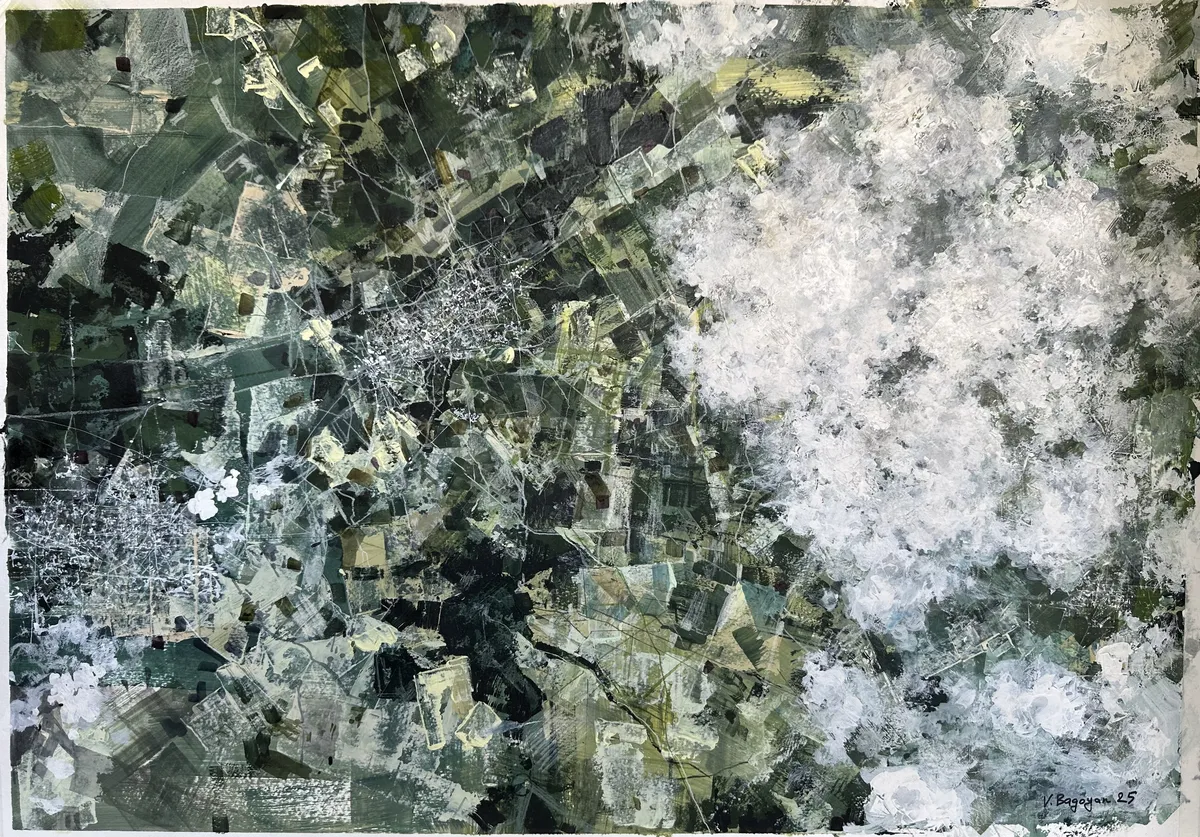
Plane of Silence
Urban Resonance
- 79.5 x 55.7 cm
€5,000
euros
Urban Resonance explores the city as a field of continuous interaction — a place shaped not only by architecture, but by movement, connections, rhythms, and invisible systems. The composition centers on a narrow horizontal urban band that stretches across an expansive, almost weightless space. Within it, fragments of color and densely accumulated marks suggest buildings, infrastructure, roads, and layers of human activity. The city appears compressed into a continuous pulse rather than represented as a conventional landscape. An intricate network of fine lines extends far beyond this central urban field. Horizontal, vertical, and diagonal trajectories intersect across the surface, suggesting flows of transportation, communication, energy, and spatial relationships. Some lines seem precise and deliberate; others drift away from any recognizable order, creating a tension between planning and unpredictability. The extensive white areas are equally important. They let the dense urban structure breathe while emphasizing the fragility of the lines that hold the composition together. The city appears simultaneously intense and almost immaterial — as though its physical form were only one layer of a much larger system. In Urban Resonance, Vahagn Bagoyan reduces the metropolis to its essential rhythms and connections. The city becomes a field of resonance — a structure whose presence extends beyond its visible boundaries through movement, tension, and the invisible relationships between its parts.
2025
Acrylic painting
- euros
€5,000
euros
Architectural Pulse
- 70 x 50 cm
- euros
€4,300
euros
Architectural Pulse explores the city as a living rhythm — an environment shaped by repetition, interruption, density, and continuous movement. The composition gathers around a broad horizontal urban field suspended within an expansive pale space. Architectural fragments, geometric planes, and small accents of blue, ochre, rust, and turquoise accumulate into a dense visual fabric. Rather than forming recognizable buildings, these elements suggest the underlying rhythm of construction — a city continually assembling, changing, and reorganizing itself. An intricate network of fine lines passes through and beyond this central structure. Vertical marks rise like structural coordinates, while diagonals and horizontals intersect across the surface, evoking routes, infrastructure, circulation, and communication systems. Their varying density creates a visual cadence: moments of compression alternate with areas of openness and silence. The restrained background allows this urban concentration to appear almost suspended in space. Its boundaries remain uncertain, as though the city were expanding through invisible connections rather than through physical form alone. In Architectural Pulse, Vahagn Bagoyan shifts attention from architecture as a collection of static objects to architecture as rhythm and process. The metropolis becomes a dynamic system whose identity emerges from the constant interaction of structures, trajectories, and human movement — the pulse that keeps the city alive.
2025
Acrylic painting
- euros
€4,300
euros
Plane of Silence
- 59 x 41 cm
- US dollars
$3,200
US dollars
Plane of Silence explores the city from an aerial perspective, where urban structures, landscape, and atmosphere coexist within a single suspended field. The work moves away from the conventional image of the metropolis and toward a more distant, almost contemplative perception of territory. Across the surface, overlapping fragments of deep green, grey, olive, and muted earth tones suggest an expansive terrain viewed from above. Within it, delicate concentrations of white linear networks emerge like traces of settlements, roads, and interconnected urban systems. Their precision contrasts with the irregular, painterly character of the surrounding landscape. A vast cloud-like formation occupies much of the composition, partially obscuring the territory beneath it. Rather than functioning simply as an atmospheric element, it becomes a zone of interruption — a space where information disappears, and the landscape can no longer be fully read. The visible city gives way to uncertainty. This relationship between detailed structure and concealment creates the work’s distinctive sense of silence. From this imagined altitude, movement becomes imperceptible, architectural density loses its noise, and the city is reduced to traces within a much larger spatial field. In Plane of Silence, Vahagn Bagoyan considers silence not as emptiness, but as a different way of perceiving space. The city remains present beneath the atmosphere, yet distance transforms its complexity into stillness — a territory suspended between visibility, memory, and disappearance.
2025
Acrylic painting
- US dollars
$3,200
US dollars